A lot of business websites have service pages, but very few have service pages that truly work. Some pages are clearly written only for SEO, so they feel robotic and repetitive. Others are visually decent but too vague to rank or convert. The best service pages are simple, useful, clear, and built around what the customer actually wants to know.
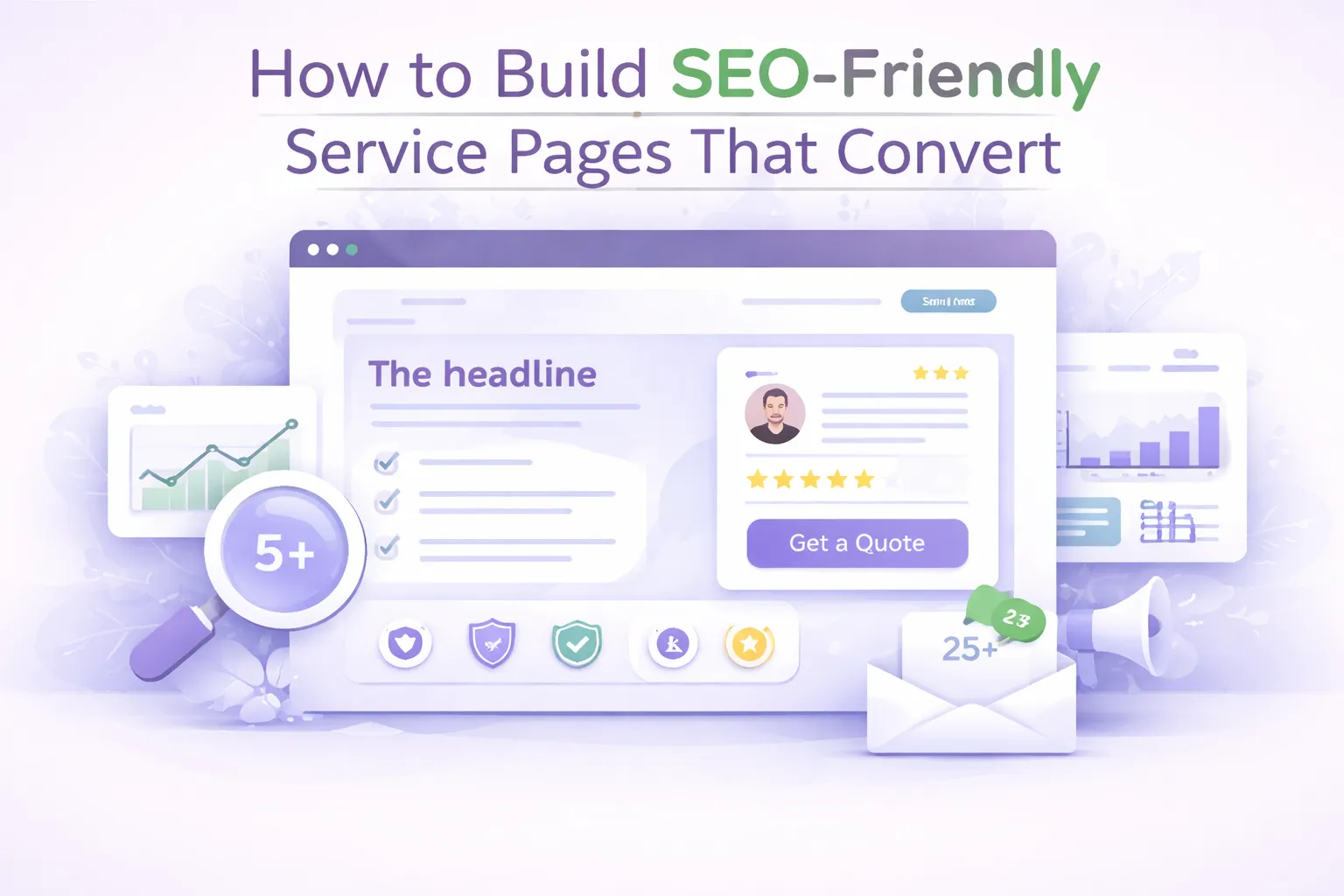
Table of Contents
If someone lands on your service page, they are usually much closer to taking action than someone reading a general blog post. They aren't casually browsing. They want to know whether you offer the right service, whether you look trustworthy, and whether it makes sense to contact you.
That is why service pages matter so much. They sit at the point where SEO meets business outcomes. If they are weak, even good rankings don't create enough value. If they are strong, they can improve both visibility and lead generation.
Why service pages matter more than most websites realize
A homepage can introduce your brand, but service pages are where search intent becomes specific. Someone searching for SEO services, website maintenance, Shopify development, or WordPress help is already looking for a solution. They aren't asking what SEO is. They are asking, often silently, “Can this person solve my problem?”
So a good service page has to answer practical questions quickly:
- what exactly do you offer?
- who is this service for?
- what outcomes can the client expect?
- why should they trust you?
- what should they do next?
If the page fails on these questions, people hesitate. That means fewer form submissions, fewer WhatsApp clicks, and weaker conversion even if the traffic is decent.
This is also why service pages should always connect back to your main commercial paths like SEO Services, your contact page, and even the homepage where users may want broader context about your business.
Start with search intent, not random keywords
One of the biggest mistakes in service page SEO is targeting keywords without understanding intent. A search term may look attractive because of volume, but if the page doesn't match what the user expects, it won't perform well.
For example, someone searching “SEO services” is looking for a provider or at least evaluating providers. Someone searching “what is SEO” is much earlier in the journey. These are different types of pages and shouldn't be forced into one.
Service pages work best when they target commercial intent clearly. That means the page should focus on the service itself, not try to become a general guide. Educational content can support that page through blogs and internal links.
This is where your internal linking map becomes powerful. A blog post can educate. A service page can convert. For example:
- a speed-related blog can link toward technical SEO and developer pages
- a Shopify blog can naturally support the Shopify service page
- a service page blog like this one should link back to SEO Services
Do not overstuff keywords
A page should mention the service naturally, but overusing the same phrase repeatedly makes the copy look weak and untrustworthy. Good service pages sound like a real business talking to a real customer, not like a machine trying to impress a search engine.
What a strong service page structure usually looks like
Service pages convert better when they are structured in a way that reduces confusion. If the user has to search for basic information, the page is doing extra damage.
A good service page usually includes:
- a clear heading that states the service
- a short hero section that explains value
- who the service is for
- what is included
- your process or approach
- trust signals or proof
- FAQ section
- visible CTA or lead form
This structure helps both people and search engines. The user can scan quickly. Google can understand the topic more clearly. Your conversion path becomes smoother.
Use one clear H1 and logical sections
Each service page should have one main topic. Then use H2s and H3s to break the content into sections that answer natural decision-making questions. Avoid cluttering the page with random blocks that don't help the user move forward.
How to write service page copy that doesn't sound robotic
A lot of service page content feels artificial because it's trying too hard to sound “SEO optimized.” In reality, better service page copy is usually clearer, calmer, and more specific.
Instead of saying:
We provide the best professional high-quality SEO services for all your business ranking needs.
it's better to say something more grounded, such as:
I help businesses improve rankings, clean up technical SEO issues, and create pages that bring more qualified leads.
The second version sounds more believable. It explains what the service is doing. It feels closer to a real conversation.
Speak to actual business concerns
Especially for Indian businesses, service page copy works better when it reflects real buyer concerns:
- Will this help me get more leads?
- Will this actually improve my current website?
- How long will it take?
- Is this practical for my business size?
- Will I understand what is being done?
Pages that answer real concerns perform better than pages full of generic marketing language.
Trust signals aren't optional on service pages
A service page can rank well and still fail if the user doesn't trust the business. Trust is one of the biggest conversion drivers, especially for services that aren't impulse buys.
Useful trust signals include:
- clear process explanation
- portfolio or work examples
- testimonials
- direct language instead of vague hype
- contact options that are easy to find
- FAQ answers that reduce hesitation
Even something as simple as a visible audit CTA or consultation offer can make a service page feel more trustworthy because it gives the user a low-friction next step.
Internal linking strategy for service pages
Internal linking is one of the most underrated parts of service page SEO. A strong internal link structure helps Google understand which pages matter, and it also helps users move naturally through your site.
For this page and your site structure, every important blog should link to:
Then you can create topic-specific cross-links:
- speed blog → technical SEO blog → developer pages
- Shopify blog → Shopify development page
- service pages blog → SEO services page
This page should also connect to supporting blog content where relevant. For example, a service page that feels slow or technically weak will struggle to convert, so it makes sense to support this topic with related resources like How to Improve Website Speed for Better SEO and Conversions and Technical SEO Mistakes That Hurt Rankings on New Websites.
If the business runs on Shopify, there is also a natural link path to Shopify SEO Basics for New Ecommerce Stores and then to the Shopify development page.
Speed, UX, and clarity affect service page SEO too
A service page isn't only about text. If the page is slow, cluttered, or frustrating on mobile, it will still underperform. That is why speed and usability matter even for content-focused pages.
Common issues include:
- oversized hero sections
- too many animations
- weak mobile layout
- poor button placement
- long forms with too many fields
If the service page is hard to use, the user may never reach the CTA. That is also why related blog content like the website speed guide supports this topic well.
Should every service have its own page?
Usually yes, if it's a meaningful service with separate search intent and separate business value. It is better to have one strong page for each important service than one overloaded page trying to rank for everything.
For example, if you offer SEO, Shopify development, WordPress development, and maintenance, separate pages usually make more sense than one giant services page trying to force every topic into the same layout.
That said, every standalone service page should still be connected through a broader hub like your services page and supported by the right internal links.
Common mistakes that make service pages weak
1. Too much vague copy
If the page sounds polished but doesn't clearly explain what is being offered, users lose interest quickly.
2. Too little content
A very thin page often struggles to rank and also doesn't build enough trust to convert.
3. No proof or trust elements
Service pages need reassurance. Otherwise the user keeps comparing and postpones contact.
4. Poor internal linking
If your service pages are isolated, they miss topical support from blogs and related pages.
5. Weak CTA placement
The page may explain the service well, but if the user can't easily take the next step, leads drop.
6. Writing only for SEO tools
A page should still feel natural and useful. SEO is important, but the page is ultimately for a person who may hire you.
Quick service page checklist
Checklist for stronger service pages
- match the page to real commercial intent
- use one clear H1 and clean section structure
- write copy that sounds human and specific
- explain outcomes, process, and who the service is for
- add trust signals and FAQs
- link to SEO Services, Contact, and Home
- support service pages with related blogs and internal links
- keep the page fast and easy to use on mobile
A strong service page doesn't need to feel fancy. It just needs to feel clear, trustworthy, relevant, and easy to act on. When those basics are handled properly, both rankings and lead quality improve.
If you want help building or improving service pages that actually support rankings and enquiries, start with the SEO services page, explore the homepage for broader context, or go directly to the contact page to discuss your website.
Frequently Asked Questions
What makes a service page SEO-friendly?
A service page becomes SEO-friendly when it matches search intent, explains the service clearly, uses strong structure, and supports the user’s decision-making without sounding forced.
How long should a service page be?
It should be long enough to answer key questions properly. In many cases, a thin page underperforms because it lacks clarity, trust, and depth.
Should service pages link to blog posts?
Yes. Relevant blog posts can support service pages by adding topical depth and improving internal linking.
Do service pages need CTAs in multiple places?
Usually yes. Users don't all decide at the same point, so it helps to have clear CTA paths near the top, middle, and end of the page.
Can a good service page improve leads without more traffic?
Yes. Sometimes the biggest improvement comes from better conversion, not just more traffic. A stronger service page can help more visitors turn into enquiries.
Need help improving your service pages?
I help businesses improve service page SEO, structure, copy clarity, trust signals, and conversion paths so the pages do a better job of ranking and generating leads.